product background
Skip to product information

Colombia

Sidra

Sidra

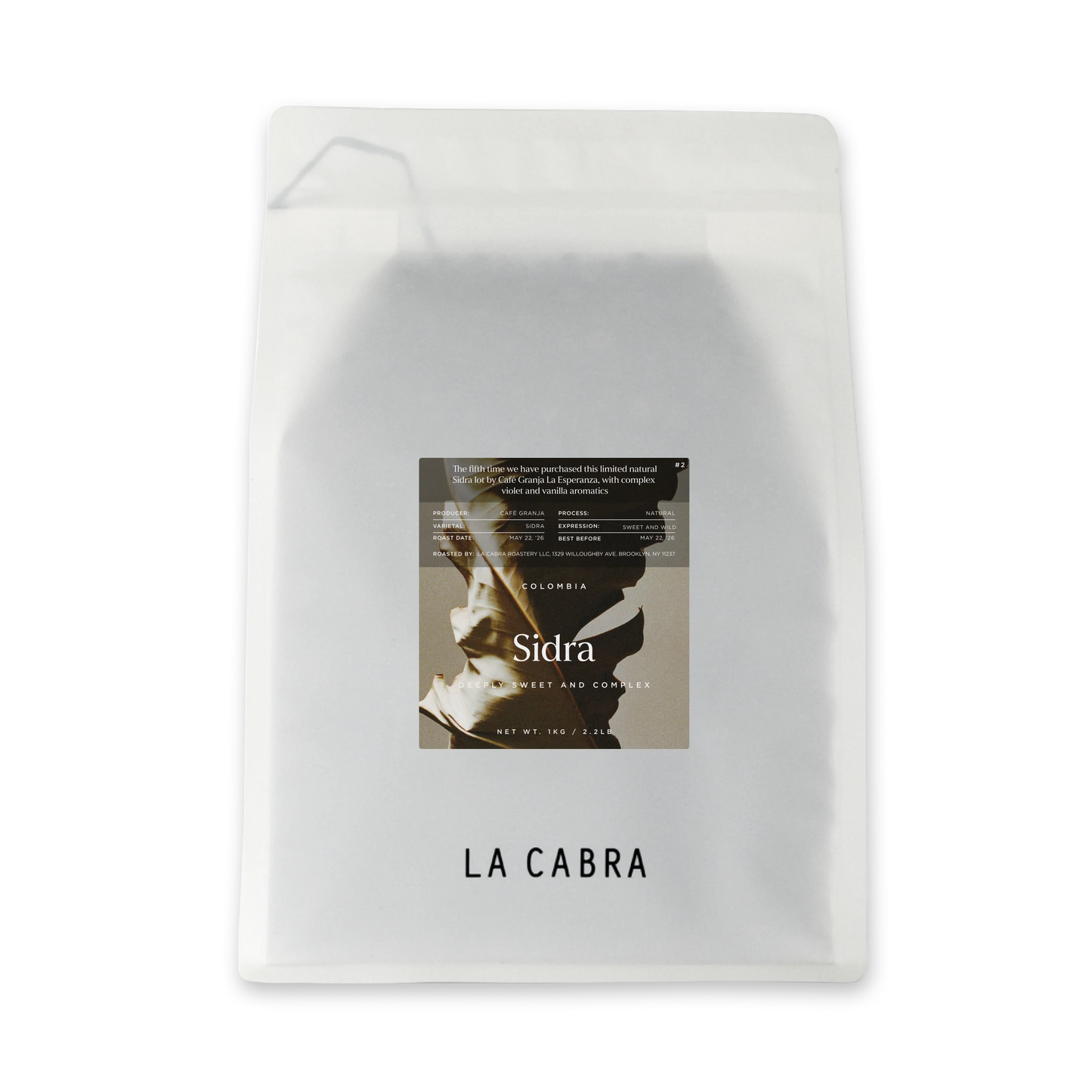
The fifth time we have purchased this limited natural Sidra lot by Café Granja La Esperanza, with complex violet and vanilla aromatics.

Regular price $46.00 USD
$46.00 USD Regular price Sale price
Amount

About

Coffee Expression A returning favourite for us; this natural Sidra showcases the sweet and round character of the varietal, both aromatically and in the cup.

Producer This natural Sidra was produced at Potosí, located near Caicedonia in the Cauca Valley.

Whole Bean Coffee / Both for filter and espresso

Technical Data

Producer Café Granja La Esperanza

Region Valle del Cauca

Altitude 1800 masl

Varietal Sidra

Process Natural

Harvest November 2025

Brewing Advice

Water is one of the most critical components of an excellent coffee experience. We recommend using mineral water of a soft Total Dissolved Solids count, ideally below 150 ppm. 

Rested coffee During the resting process, harsh and astringent flavors, which can even be perceived as a ‘roast’ character, soften out, allowing a clearer and brighter expression of the coffee’s character to shine.  

We recommend resting our coffees for at least 10 days after the roast date, and we often find excellent results, especially for particularly dense coffees, beyond 6 weeks.

Brewing Our straightforward approach to coffee carries over into brewing. We recommend our roasted coffee for all brew methods, regardless of whether it is immersion, percolation or espresso. We believe that there is one correct way to roast a single coffee, roasting lightly, in such a way as to release its innate qualities and showcase its quality. Learn more about different brewing techniques and specific brew guides here.

Shipping & Delivery

· Free shipping above $79 and on all subscription orders

· Ships within 1-3 days from Brooklyn, New York

· More info

View full details

Potosí Sidra

A returning favourite for us, this is the fifth year we have purchased this natural Sidra lot, grown on Finca Potosí. Rigoberto Herrera was inspired to plant Sidra after a trip to Ecuador in 2016, where he visited the varietal’s origin, a large Ecuadorian research farm funded by Nestlé. Unlike many modern hybrids, it was created with the sole aim of creating a high quality cup profile, with the best aspects of both its parent varietals, the heavy sweet character of Bourbon, and the florals that Typica is so well known for. After the varietal’s explosion of popularity in Ecuador, Rigoberto sourced Sidra seeds and oversaw the planting of a nursery in October 2016. These plants were taken to the fields of Potosí in April 2017, and now number almost 4000, spread across a 1.5 hectare plot high on the Potosí ridge.

This lot, like in previous years, was processed using a natural method with Granja’s trademark level of attention to detail. Carefully hand-picked cherries are first fermented in open tanks for 24 hours before fermenting again in closed tanks for a further 50. This allows time for complexity and wild flavour characteristics to build within the coffee before it is sent to mechanical driers to dry slowly over 12 days.

This enhances the intensely round and sweet character of the Sidra varietal, emphasising the floral violet and vanilla aromas, and creating soft and ripe tropical fruit notes.

Café Granja La Esperanza

The Herrera family purchased Finca Potosí in 1945 and planted several varieties that were unusual for Colombia at the time, including yellow and red Bourbon. This started the Granja tradition of experimentation, leading to some recognition by other farmers in the Cauca Valley. The large family of 14 children did much of the work on the farm themselves, but two brothers took particular interest in coffee production, and in the late 1990’s, Rigoberto and Luis took over the family business and started the push towards what Granja is now. They purchased small farms to add to their portfolio, and began the process of converting all of their coffee growing to use organic farming practices. They also looked outside Colombia for further insight, and jumped at the opportunity to lease a small farm in Panama. Rigoberto moved, and his years of producing experience led to a lot of their Geisha winning the prestigious Best of Panama within 2 years.

When Rigoberto returned to Granja, he brought back not only experience, but Panamanian Geisha seeds. These seeds were the foundation for the next stage of growth, beginning to chase distinct flavour profiles and the super high end specialty market. The experience of bringing a Panamanian varietal to Colombia was pivotal to Granja in their endeavour to adapt more exotic varietals to the Colombian soil, showcasing a wide view of the Cauca Valley terroir.

They have also begun to experiment with unique processing, using open and closed tank fermentations to create incredible control over fermentation, for both their washed and natural coffees. They also use mechanical drying extensively, allowing very tight control over length and degree of drying. This type of fermentation results in very low water usage, compared especially to traditional washed processing. This is another of Granja’s core values, focussing on sustainability. They have also worked very hard on maintaining local floral and fauna, using waste products from the farm to fire their mechanical driers, and switching to organic farming methods.

You might also like